
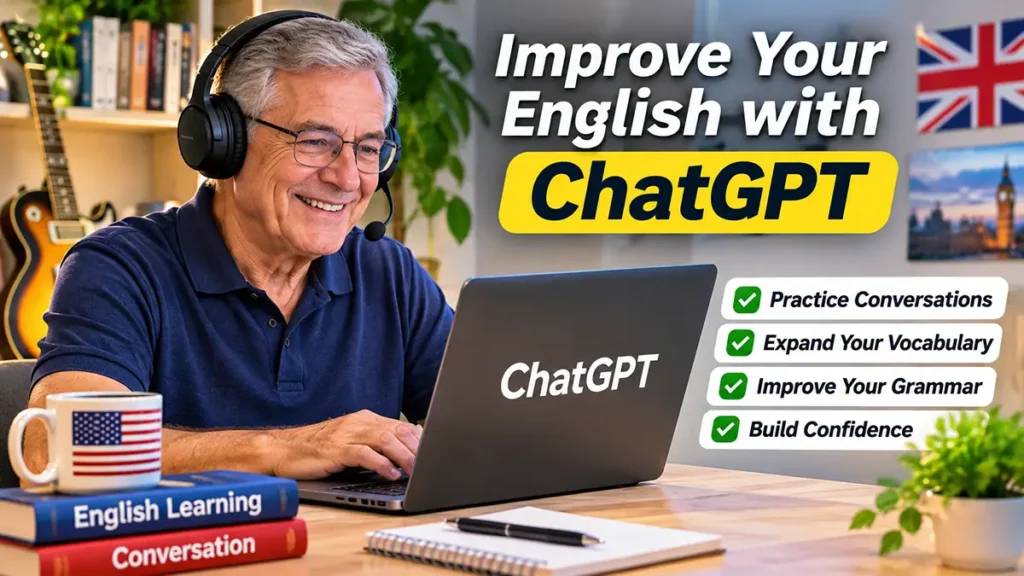
Learning how to use ChatGPT to improve your English can make language practice easier and more accessible. Whether you’re a complete beginner or someone looking to build confidence, ChatGPT can help you practice everyday conversations, vocabulary, and grammar at your own pace..
In this beginner-friendly guide, you’ll discover how to use ChatGPT to improve your English through everyday conversations, vocabulary exercises, grammar corrections, and practical learning activities.
Whether you want to speak more confidently, understand English conversations, or feel more comfortable watching movies in English, ChatGPT can be a helpful practice partner.
You don’t need advanced English skills or expensive software to get started. With a few simple prompts and consistent practice, you can begin building your English skills at your own pace.
Why Use ChatGPT to Practice English?
Learning a new language takes time, patience, and regular practice. One of the biggest challenges for English learners is finding opportunities to practice without feeling embarrassed about making mistakes.
ChatGPT can help by providing a comfortable environment where you can practice English at your own pace. You can ask questions, write sentences, simulate everyday conversations, and receive suggestions to improve your grammar and vocabulary. If you’re new to ChatGPT, start with our step-by-step guide to using ChatGPT for beginners before exploring these English practice activities.
In addition, ChatGPT offers flexibility. Whether you have five minutes or half an hour, you can practice whenever it fits your schedule. As a result, it’s easier to include English practice in your daily routine.
Here are some ways ChatGPT can support your English learning:
- Conversation practice: Practice everyday situations, such as ordering food, introducing yourself, or asking for directions.
- Grammar corrections: Identify mistakes in your sentences and learn how to correct them.
- Vocabulary building: Discover useful words and expressions commonly used in everyday English.
- Writing practice: Improve emails, messages, and short paragraphs.
- Speaking and listening: Use ChatGPT’s voice features, when available, to practice pronunciation and listening comprehension.
ChatGPT is not a complete replacement for conversations with native speakers, but it can be a useful learning companion that helps you build confidence through consistent practice.
How to Use ChatGPT to Improve Your English: Getting Started
Getting started with ChatGPT is simple, even if you’re completely new to learning English. You don’t need advanced technical skills or previous experience with artificial intelligence.
Follow these steps to begin practicing.
Step 1: Open ChatGPT
Visit ChatGPT on your computer, tablet, or smartphone. Sign in to your account or follow the instructions to get started.
Once you’re ready, you’ll see a chat interface where you can type questions, instructions, or practice exercises.
Step 2: Tell ChatGPT Your English Level
Before starting a conversation, explain your current English level and what you want to achieve.
For example, you can type:
“I’m a beginner learning English. Please use simple words, short sentences, and correct my mistakes. Explain difficult expressions when necessary.”
This helps ChatGPT adapt its responses to your learning needs.
Step 3: Start a Simple Conversation
Begin with an everyday topic, such as introducing yourself or talking about your daily routine.
Try this prompt:
“Let’s practice a simple English conversation. Ask me one question at a time about my daily routine. Wait for my answer and correct any mistakes.”
You can respond in English, receive feedback, and continue practicing naturally.
Step 4: Ask for Corrections and Explanations
Don’t worry about making mistakes. Errors are a normal part of learning a language.
When you write something incorrectly, ask ChatGPT to explain the correction in simple English.
For example:
“Please correct my sentence, explain what I did wrong, and show me a more natural way to say it.”
This approach helps you understand your mistakes instead of simply memorizing corrections.
Step 5: Practice Regularly
Consistency is more important than studying for long periods occasionally.
Try practicing for 10 to 15 minutes each day. You can review vocabulary, answer questions, or simulate conversations about familiar subjects.
As your confidence grows, gradually introduce more challenging topics and longer conversations.
How to Use ChatGPT to Improve Your English Through Conversations
One of the best ways to use ChatGPT to improve your English is to practice conversations about everyday situations. These exercises can help you become more comfortable forming sentences, asking questions, and responding naturally.
You can practice at your own pace and repeat conversations as many times as you need.
Practice 1: Introducing Yourself
Start with a simple conversation about your name, where you live, and your interests.
Example prompt:
“Act as a friendly American English conversation partner. Ask me simple questions about myself, one at a time. Correct my mistakes and explain the corrections.”
You might practice sentences such as:
- “My name is John.”
- “I live in New York.”
- “I enjoy listening to music.”
Practice 2: Ordering Food at a Restaurant
Restaurant conversations are useful because they involve common expressions you may encounter when traveling.
Example prompt:
“Let’s practice ordering food at an American restaurant. You are the waiter, and I am the customer. Use simple English and help me correct my answers.”
You can practice expressions like:
- “Could I see the menu, please?”
- “I’d like a chicken sandwich.”
- “Can I have the check, please?”
Practice 3: Talking About Your Daily Routine
Describing everyday activities helps you practice common verbs and sentence structures.
Example prompt:
“Ask me five simple questions about my daily routine. Wait for each answer, correct my grammar, and suggest a more natural way to express my ideas.”
For example:
- “I wake up at seven in the morning.”
- “I go to the gym before breakfast.”
- “I usually watch television in the evening.”
Practice 4: Talking About Music and Hobbies
Practicing familiar subjects can make conversations more enjoyable and help you express your opinions.
Example prompt:
“Let’s have a beginner-friendly conversation about music and hobbies. Ask me one question at a time, correct my mistakes, and teach me useful everyday expressions.”
You could practice sentences such as:
- “I enjoy playing the guitar.”
- “My favorite music genres are rock and pop.”
- “I like listening to music in my free time.”
Make Your Conversations More Natural
As your English improves, ask ChatGPT to use more natural expressions and gradually introduce longer questions.
You can also request American or British English, depending on your learning goals.
Remember that making mistakes is part of the learning process. The goal is to communicate more confidently, not to speak perfectly from the beginning.
Improve Your English Pronunciation and Listening with ChatGPT
Learning English isn’t just about reading and writing. Speaking clearly and understanding spoken English are also important skills, especially if you want to communicate with native speakers or enjoy movies and television shows in English.
ChatGPT’s voice features can help you practice speaking and listening through interactive conversations.
Use Voice Mode to Practice Speaking
When voice conversations are available in your version of ChatGPT, you can speak directly to the assistant instead of typing your responses.
To get started, open ChatGPT and look for the voice feature. Depending on your device and interface, you may see a voice icon near the message box.
Once voice mode is active, try this prompt:
“Let’s practice speaking American English. I’m a beginner, so please speak slowly, use simple sentences, and ask me one question at a time.”
Listen carefully and answer aloud. If you don’t understand something, ask ChatGPT to repeat or explain it.
Practice Pronunciation with Short Sentences
Start with common expressions that you might use in everyday conversations.
For example:
- “How are you doing today?”
- “Could you repeat that, please?”
- “I’d like a cup of coffee.”
- “What do you usually do on weekends?”
Ask ChatGPT to model the pronunciation and let you practice each sentence.
Example prompt:
“Help me practice the pronunciation of five common English sentences. Say each sentence clearly, let me repeat it, and give me feedback.”
Remember that automated pronunciation feedback may not always identify every sound accurately. Use it as practice rather than a perfect assessment of your accent.
Improve Your Listening Comprehension
Understanding spoken English can be difficult because native speakers often connect words and use expressions that aren’t obvious to beginners.
You can ask ChatGPT to create short listening exercises using familiar situations.
Example prompt:
“Tell me a short story in simple American English. Then ask me three questions to check what I understood. Speak at a beginner-friendly pace.”
Try answering the questions without reading the text first. This helps you focus on listening rather than translating every word.
Practice Understanding Movies and TV Conversations
Movies and television shows can introduce you to natural expressions, different accents, and everyday vocabulary.
Ask ChatGPT to create short, original dialogues similar to conversations you might hear in everyday life.
Example prompt:
“Create a short, natural conversation between two American friends. Read it aloud, explain any unfamiliar expressions, and ask me questions about what they said.”
As you improve, gradually increase the speaking speed and practice with different accents.
The goal is to become more comfortable understanding spoken English over time, even when you don’t recognize every word.
Build Your English Vocabulary and Improve Grammar with ChatGPT
Building vocabulary and understanding grammar are essential parts of learning English. However, memorizing long lists of words or studying complicated grammar rules can sometimes feel overwhelming.
ChatGPT can make these activities more practical by helping you learn useful expressions, understand common mistakes, and practice new words in everyday situations.
Learn Useful English Words Every Day
Instead of trying to memorize dozens of words at once, focus on a small number of expressions that you can use in real conversations.
For example, ask ChatGPT to teach you five new words related to a familiar topic, such as food, travel, work, or hobbies.
Example prompt:
“Teach me five useful American English words for everyday conversations. Explain their meanings, provide example sentences, and give me a short quiz.”
Try writing your own sentences with each new word. This helps you remember vocabulary through practical use.
Understand Grammar Through Simple Examples
Grammar becomes easier to understand when you see how it works in everyday sentences.
For example, beginners often confuse the present simple and present continuous tenses.
Compare these sentences:
- “I play the guitar every day.”
- “I am playing the guitar right now.”
The first sentence describes a regular activity, while the second describes something happening at the moment.
Example prompt:
“Explain the difference between the present simple and present continuous in easy English. Give me five examples and a short exercise.”
Correct Your English Sentences
One useful way to improve your grammar is to write sentences and ask ChatGPT to review them.
For example:
Your sentence: “I go to gym every morning.”
Corrected sentence: “I go to the gym every morning.”
ChatGPT can explain why the article “the” is needed in this expression.
Example prompt:
“Correct my English sentences. Explain each mistake in simple language and show me how a native speaker would naturally express the same idea.”
Review Vocabulary with Short Quizzes
Regular review helps you remember what you’ve learned.
Ask ChatGPT to create short quizzes based on the vocabulary you practiced earlier.
Example prompt:
“Create a five-question vocabulary quiz using the English words we studied today. Ask one question at a time, wait for my answer, and explain any mistakes.”
You can also ask ChatGPT to revisit words you found difficult and include them in future exercises.
By combining vocabulary practice, grammar explanations, sentence corrections, and regular review, you can gradually build a stronger foundation in English.
Create a 15-Minute Daily English Practice Routine with ChatGPT
You don’t need to spend hours studying English every day to make progress. A short, consistent routine can help you develop your skills and build confidence over time.
With ChatGPT, you can organize a simple 15-minute practice session that combines conversation, vocabulary, grammar, and listening activities.
Minutes 1–5: Practice a Short Conversation
Start by talking about something familiar, such as your daily routine, favorite foods, or hobbies.
Example prompt:
“Let’s have a five-minute conversation in simple American English. Ask me one question at a time, correct my mistakes, and help me respond naturally.”
Try to answer using complete sentences, even if your responses are short.
Minutes 6–10: Learn and Review Vocabulary
Spend the next five minutes learning useful expressions and reviewing words from previous sessions.
Example prompt:
“Teach me three useful English expressions for everyday conversations. Give me examples and quiz me on words I learned earlier in this chat.”
Write your own sentence using each expression.
Minutes 11–15: Practice Listening and Pronunciation
Finish your session with a short speaking or listening exercise.
If voice mode is available, ask ChatGPT to read a few sentences aloud and let you repeat them.
Example prompt:
“Help me practice listening and pronunciation for five minutes. Use short American English sentences, speak clearly, and ask me simple questions about what I heard.”
If you’re using text chat, you can practice reading sentences aloud and request explanations of unfamiliar words.
Track Your Progress Each Week
At the end of each week, review what you’ve learned.
Ask ChatGPT to help you identify recurring grammar mistakes, review vocabulary, and suggest topics for future practice.
Example prompt:
“Review our English practice in this conversation. Identify my most common mistakes, list the vocabulary we’ve studied, and suggest three goals for next week.”
For more reliable progress tracking, keep a simple notebook or document with your new words, corrected sentences, and weekly goals. ChatGPT may not have access to every previous practice session.
Remember that consistency matters more than perfection. Even a short daily routine can help you develop better learning habits and gradually improve your English.
Common Mistakes to Avoid When Learning English with ChatGPT
ChatGPT can be a helpful tool for learning English, but how you use it can make a difference in your progress. Beginners sometimes develop habits that limit their opportunities to practice and improve.
Here are some common mistakes to avoid.
1. Relying Too Much on Translation
Translating every sentence into your native language may seem helpful at first, but it can make it harder to think directly in English.
Instead, try understanding simple English explanations before requesting a translation.
Example prompt:
“Explain this sentence in simple English first. If I still don’t understand, translate it into my native language.”
2. Asking ChatGPT to Do All the Work
If ChatGPT always writes complete answers for you, you may miss opportunities to develop your own communication skills.
Try writing or speaking your response first, even if you make mistakes.
Example prompt:
“Don’t answer the question for me. Give me time to respond, then correct my mistakes and explain how I can improve.”
3. Practicing Without Reviewing Mistakes
Making mistakes is a natural part of learning, but reviewing them helps you recognize patterns and avoid repeating the same errors.
Keep a record of corrected sentences and revisit them regularly.
Example prompt:
“Review the mistakes I made during this conversation. Explain the three most important corrections and give me exercises to practice them.”
4. Using Only Text Instead of Speaking
Reading and writing are valuable skills, but they don’t fully prepare you for real conversations.
When possible, combine text exercises with speaking and listening practice using ChatGPT’s voice features.
You can also practice with language partners, podcasts, and beginner-friendly videos to experience different voices and accents.
5. Expecting Perfect Answers Every Time
ChatGPT can occasionally provide incorrect explanations, unnatural expressions, or inconsistent feedback.
If a correction seems confusing, ask for another explanation or compare it with a reliable English-learning resource.
Example prompt:
“Explain why this correction is appropriate. Give me two natural examples and tell me whether the expression is common in American English.”
Remember that ChatGPT works best as a practice companion rather than your only source of language instruction.
By avoiding these mistakes, you can make your English practice more active, balanced, and effective.
Final Thoughts: Improve Your English with ChatGPT
Learning how to use ChatGPT to improve your English can be a practical way to develop your language skills at your own pace.
From everyday conversations and vocabulary exercises to grammar corrections and pronunciation practice, ChatGPT offers several ways to make English learning more interactive and accessible.
Remember that progress takes time. Start with simple exercises, practice regularly, and gradually challenge yourself with new topics and conversations.
Most importantly, don’t be afraid to make mistakes. Every conversation is an opportunity to learn something new.
Ready to get started? Open ChatGPT, choose a familiar topic, and begin your first English practice session today!
Pingback: How to Use ChatGPT to Plan Your Day | Beginner’s Guide